

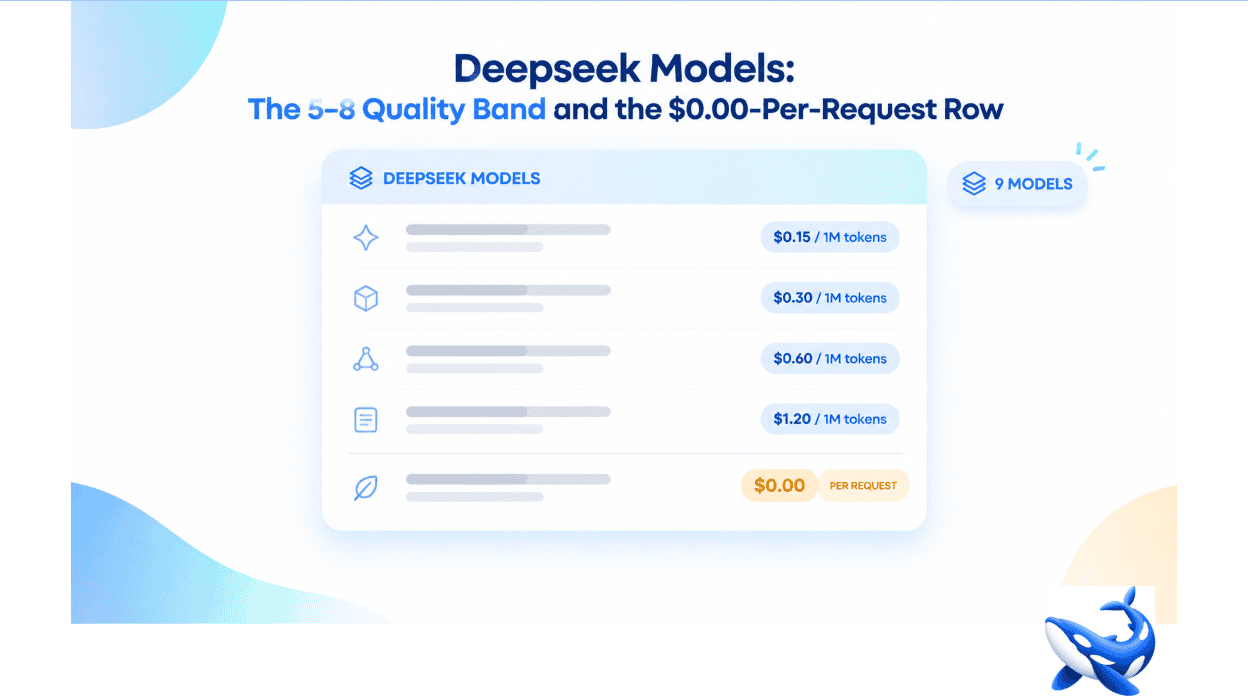
Take one megabyte of text, roughly a million characters, or about 250,000 English words. Send it through DeepSeek V4 Flash on OrcaRouter and the Deepseek Models rate card charges $0.220 for that million input tokens and $0.660 for every million the model writes back. Now send the same volume as requests: if your average call carries 4,000 tokens, a million tokens is 250 requests, and the catalogue’s last row is priced at $0.00 per request. The same volume, two billing units, and no exchange rate between them. That single mismatch is the most interesting thing on a nine-row page.
The other eight rows are priced the way you expect. Sorting them by score shows a clean band: read on our own 0-to-10 composite — the score we build ourselves from the dimensions we grade each model on, not a third-party benchmark — the rows run from 5 to 8, with DeepSeek V4.1 Flash and DeepSeek V4 Pro at the top of the band and DeepSeek V3 and deepseek/deepseek-reasoner at the bottom.
Table of Contents
The band, read as a list
The nine rows break into a small number of price points rather than nine distinct ones, which is what makes the page quick to read.
| Model | Input / M | Output / M | Context (table column) | Quality (our composite, 0–10) |
| DeepSeek V4.1 Flash | $0.150 | $0.600 | 1M / 384K out | 8 |
| DeepSeek V4 Pro | $0.660 | $1.98 | 1M | 8 |
| DeepSeek V4 Pro 0813 | $0.660 | $1.98 | 1M | 7 |
| DeepSeek V4 Flash | $0.220 | $0.660 | 1M | 7 |
| DeepSeek V4 Flash Vision (Exp) | $0.220 | $0.660 | 1M | 7 |
| DeepSeek V4 Flash 0731 | $0.220 | $0.660 | 1M | 6 |
| DeepSeek V3 | $0.220 | $0.660 | 1M | 5 |
| deepseek/deepseek-reasoner | $0.242 | $0.726 | 1M | 5 |
Those rates are the provider’s published per-million-token figures as printed on the page [VENDOR]. The quality column is a 0-to-10 composite we build ourselves from the dimensions we grade each model on — our own measure, not a third-party benchmark score.
Read the band and two patterns surface. First, the rows that share a price point do not share a composite score: four rows sit at $0.220 / $0.660 and carry three different digits on our own 0-to-10 composite between them, and each dated variant sits one point below its base row. In other words, the score is doing the discriminating work here, not price — if two rows cost the same, the digit is the only thing separating them.
Second, the top of the band is not the top of the price column. DeepSeek V4.1 Flash is the cheapest row on the page at $0.150 / $0.600 and it carries the joint-highest composite score at 8, level with the dearest row, DeepSeek V4 Pro at $0.660 / $1.98 — a placement we calculate on our own composite, not a third-party ranking. A reader who assumes the strongest row must be the expensive one will pick the wrong row here.
Then there is the ninth row
The last row on the page does not look like the others. Instead of an input rate and an output rate, it prints a single figure — $0.00 per request — and the input, output and cached columns beside it are missing rather than filled. DeepSeek V4 Flash (Free) sits in the same catalogue as the eight token-billed rows, and its price cell has been formatted for a different billing unit.
That is worth reading carefully, because “$0.00” is the kind of number that gets repeated without its unit attached.
It is not free tokens. The row is billed per request, not per token. Those are different meters, and the difference is not cosmetic. A per-token bill scales with volume: longer prompts and longer answers cost more, and cost tracks your token count roughly linearly. A per-request bill does not scale with length at all — under per-request pricing a 500-token call and a 5,000-token call are the same line item, and the only quantity that moves the bill is how many requests you send.
The practical consequence is that the two rows cannot be compared by dividing one price by the other, because the units do not cancel. At $0.220 per million input tokens, a million tokens costs $0.22 on DeepSeek V4 Flash. At $0.00 per request, the same million tokens costs nothing if you pack them into a few large requests and nothing if you split them into a thousand small ones. The token rate and the request rate are not two prices for the same thing; they are two different questions being asked of the same row.
What the row tells you honestly is this: the page has decided that this model is metered by the call and priced at zero per call. What it does not tell you is that tokens are unmetered in any general sense, or that the arrangement is a substitute for a per-token row in a cost model. A request-metered row belongs in a bill estimate as a request count, not as a token rate with a zero in it.
The same shape appears elsewhere in the catalogue
The per-request unit is not unique to this row — the page’s direction of travel is simply visible here first. A catalogue that mixes units has to keep them legible, and the way this page does that is to print the unit inside the price cell rather than in a footnote. A row that says $0.220 is per million tokens; a row that says $0.00 per request is per request; the words in the cell are the contract.
For a reader building a cost model, that means the first pass over any catalogue table is a unit check, not a price check. Group the rows by unit, then rank inside each group. Rows that share a unit can be compared directly. Rows in different units need your own workload plugged in — a request count for the request-metered rows, a token count for the token-metered ones — and only then do the two groups land on the same axis.
There is a second reason to do that pass early. A request-metered row is only cheap or dear relative to a token-metered row depending on how long your requests are. Short requests suit per-request pricing; long ones suit per-token pricing. Which of the two meters wins is a property of your workload, not of the table, and the table cannot answer it for you no matter how it is formatted.
Capabilities as a second filter
Price and unit decide what a row costs. They do not decide whether it can do the job. The page counts capabilities across the catalogue: JSON mode on all nine rows, tool calling on eight, reasoning on eight, and vision on two. That is a text-and-structured-output catalogue with vision at the edge, and it filters the eight token-billed rows faster than the price column does when your job is image understanding.
The takeaway
Nine DeepSeek models sit on one page, eight of them inside a 5-to-8 band on our own composite, all of them text-and-JSON first. The price column alone will not sort them: the cheapest row, DeepSeek V4.1 Flash, carries the same top composite score as the dearest, and four rows share a price point across three different composite scores. Then the ninth row changes the unit, and the unit is the point. Billed per request at $0.00 is a different meter from billed per million tokens, and a cost model that drops it into a token column will read as free when it means something else. Check the unit, then the price, then the digit.
Sourcing note: the model count, the pricing table, the per-request row, the context figures, the capability counts and the header statistics come from the OrcaRouter DeepSeek catalogue page. Published per-million-token rates and vendor-declared context and capability figures are the provider’s own [VENDOR], presented on our catalogue page [OURS]; the median p50 and model-page telemetry are our own production data [OURS]. The 0-to-10 quality column is our own composite, built from the dimensions we grade each model on, and is not a third-party benchmark. The token-versus-request comparisons are arithmetic on the published figures at a stated request size, not published statistics. All figures read 2026-10-14.


